
History of Fraser Island (K'gari)
Ancient Geological Origins – The Land Made of Sand
Fraser Island (K’gari) is the largest sand island in the world, stretching more than 120 km in length and covering roughly 184,000 hectares. Its size and variety of landscapes make it a place of extraordinary natural beauty and ecological importance.
The island is famous for its long, pristine beaches—over 250 km of golden coastline—with striking coloured sand cliffs, dramatic dune blowouts, and surf beaches that seem to run endlessly into the horizon. Even more remarkable are the lush rainforests that rise directly out of the sand—one of the only places on Earth where tall forests grow on such nutrient-poor ground.
Fraser Island is also home to more than 40 perched freshwater lakes—formed when rainwater collects above the water table, sealed in by layers of compacted sand and organic matter. This makes it the single largest concentration of perched lakes anywhere in the world. Lake Boomanjin is the biggest perched lake on Earth, Lake McKenzie is renowned for its clear blue waters and white silica sands, and Lake Wabby—up to 12 m deep—is slowly being swallowed by the Hammerstone Sand Blow.
Alongside these lakes are dune systems that have been evolving for over 750,000 years, shaped by wind and tide into patterned fens, banksia woodlands, and coastal heathlands. Together, these features create an environment of outstanding global significance—earning Fraser Island (K’gari) recognition as both a National Park and a UNESCO World Heritage site.
European History – Fraser Islands Name and Eliza Fraser
One of the most dramatic and enduring European stories tied to Fraser Island (K’gari) is that of Eliza Fraser—whose name today lives on in “Eliza Street,” where Orchid Blue stands.
In 1836, Eliza was aboard the brig Stirling Castle, captained by her husband James Fraser, when the vessel struck a reef off Queensland’s coast. Survivors made it ashore on Fraser Island, but conditions were harsh and food scarce. Captain Fraser later died, leaving Eliza among the last remaining survivors.
Her tale truly began once she was taken in by the Butchulla people, the island’s Traditional Custodians. In her retelling, Eliza described the experience as one of suffering and captivity—stories that played well in Victorian England, where accounts of colonial “ordeals” captured the public imagination. She returned to Europe and toured widely, recounting her survival in front of audiences, profiting from the drama of her story.
Historians now argue her account was exaggerated or misinterpreted. Evidence suggests the Butchulla people were likely caring for her, offering food and protection according to their cultural practices. Yet her depiction painted them in a negative light—fueling colonial stereotypes at the time.
Regardless, the story of Eliza Fraser shaped how Europeans came to know the island. Her ordeal gave rise to the name “Fraser Island,” and her legacy remains both famous and controversial. Today, while her story is still told, the restoration of the island’s traditional name—K’gari—reflects a deeper acknowledgement of the Butchulla people’s history that predates her by thousands of years.
European Contact & Colonial Impact
European contact with Fraser Island (K’gari) began in 1770, when Captain James Cook sailed along the coast. He recorded seeing Butchulla people on the headland he named “Indian Head,” though he did not realise at the time that this was an island separate from the mainland.
Through the early 19th century, whalers, sealers, and passing ships occasionally made landfall. But it was the 1836 wreck of the Stirling Castle—and the survival of Eliza Fraser—that pushed the island into broader European consciousness. Her dramatic story of endurance and rescue resonated strongly in colonial society and permanently associated her name with the island.
From then, colonial expansion accelerated. By the mid-1800s, Europeans sought to extract resources, establish small settlements, and use the island’s waters for shipping. These activities disrupted the Butchulla people’s long-standing way of life, displacing them from areas that had been inhabited for thousands of years.
The European presence also changed the identity of the island itself: from a place of Indigenous heritage and sustainable living, it became a site of colonial industry and commerce. This phase marked the beginning of large-scale transformation—from isolated coastal landscape to resource-rich frontier—setting the stage for logging, sand mining, and later conservation efforts.
Logging and Sand Mining Industry
By the mid-1800s, Fraser Island (K’gari) had become a focus for timber extraction. Logging began around 1863, when operators such as “Yankee Jack” Piggott harvested kauri pine, hoop pine, and cypress pine. These woods were valued for construction and furniture-making, supplying both local and international demand.
Over time, satinay became the most prized timber. Its natural resistance to marine borers made it ideal for large-scale engineering projects. Satinay logs from Fraser Island were exported worldwide, including for rebuilding London’s docks after World War II. This gave the island’s timber industry a global footprint and lasting historical significance.
In the 20th century, the island’s resource value shifted toward sand mining. Heavy mineral sands, rich in rutile, ilmenite, zircon, and monazite, were extracted for use in industries such as steelmaking and paint production. Mining operations employed local workers and brought economic activity to the Fraser Coast region.
During World War II, parts of the island were also repurposed for military training, including as a base for Z-Force commandos. The remains of camps and equipment can still be found in the bush today, blending industrial history with military heritage.
Together, logging and mining represented major phases of European activity on Fraser Island—industries that shaped both the landscape and its role in Queensland’s development.
Conservation and World Heritage Listing
By the late 20th century, growing awareness of Fraser Island’s (K’gari’s) unique natural values led to calls for conservation. In 1971, the island was officially incorporated into the Great Sandy National Park, securing protection for much of its diverse environments under Queensland legislation.
Two decades later, in 1992, Fraser Island was recognised internationally with a UNESCO World Heritage listing. The listing highlighted its extraordinary global significance: not only as the world’s largest sand island, but also for its exceptional dune systems, rainforests, and freshwater lakes. UNESCO noted the rare phenomenon of tall rainforests thriving on sandy soils, as well as the sheer number and diversity of perched lakes.
The listing marked a turning point—acknowledging that Fraser Island was more than a resource hub; it was a living landscape of geological, ecological, and cultural value. Since then, management has balanced conservation, tourism, and cultural recognition.
In 2023, the name “K’gari” was officially restored, reflecting the Butchulla people’s enduring connection to the island. Today, Fraser Island (K’gari) is celebrated not only as a natural wonder, but also as a place where history, culture, and nature come together in a globally significant heritage site.
Historical Timeline
1770 – Captain Cook’s Sighting
James Cook sails up the coast and records seeing Butchulla people on a rocky headland he names “Indian Head.” At the time, he assumes Fraser Island is part of the mainland.
1836 – The Stirling Castle Shipwreck
The brig Stirling Castle is wrecked. Eliza Fraser survives and her dramatic account later makes her name synonymous with the island.
1863 – Logging Begins
Kauri pine, hoop pine, and cypress are harvested. Timber becomes the first large-scale industry on Fraser Island.
1920s – Satinay Timber Exported
Satinay, valued for its resistance to marine borers, is exported globally, including for the rebuilding of London’s docks.
Mid-1900s – Sand Mining Starts
Operations begin extracting rutile, zircon, ilmenite, and monazite from the island’s sands, driving a new phase of industry.
1940s – World War II Training
The island is used by Z-Force commandos as a training ground. Remnants of this activity can still be found today.
1971 – National Park Designation
Fraser Island is incorporated into the Great Sandy National Park, beginning formal conservation protection.
1992 – UNESCO World Heritage Listing
The island is recognised for its outstanding natural beauty and ecological significance.
2023 – Name Restored to K’gari
The traditional name K’gari is officially reinstated, acknowledging the Butchulla people’s enduring connection to the island.
Fun Facts About Fraser Island (K’gari)
Largest Sand Island in the World
Fraser Island stretches over 120 km in length and covers around 184,000 hectares, making it the biggest sand island on Earth.
Highest Sand Dune
The island’s tallest point is Mount Bowarrady (also known as Bowarrady Hill or Boomerang Hill), reaching 244 metres (801 feet) above sea level in the northern-central interior of the island. Unlike typical desert dunes, it’s stabilised by rich, high-elevation rainforest growing directly out of the sand mass.
More Than 40 Perched Lakes
Fraser Island is home to half of the world’s perched lakes—formed when rainwater collects above the water table.
Biggest Lake: Lake Boomanjin, the largest perched lake in the world, covers around 200 hectares. Its tea-coloured water is stained by tannins from surrounding vegetation.
Deepest Lake: Lake Wabby, up to 12 metres deep, is slowly being swallowed by the Hammerstone Sand Blow at the rate of 1m per year!
Lake McKenzie’s Pure White Sands
Lake McKenzie is one of the island’s most famous attractions, with water so clear and pure it’s almost like glass. The sand here is made of pure silica, so soft and white it squeaks underfoot. The water is so pristine and low in nutrients that no fish or plant life can survive in it. Visitors often notice the water feels silky, and the sand has historically been used to clean jewellery and even polish skin.
Rainforests Growing on Sand
Fraser Island is one of the only places on Earth where towering rainforests grow entirely on sand. Satinay and brush box trees reach over 50 metres high despite the nutrient-poor soils.
Purest Population of Dingoes
The island is home to one of Australia’s most genetically pure dingo populations, known as “Wongari.” Their isolation has protected them from cross-breeding with domestic dogs.
Birdwatcher’s Paradise
More than 350 bird species have been recorded, including sea eagles, kingfishers, honeyeaters, and migratory waders stopping along the coastline.
Shipwreck Coast
The SS Maheno, wrecked in 1935, is the island’s most iconic shipwreck and a highlight of 75 Mile Beach. Many other vessels have met the same fate along this stretch of treacherous coastline.
Timber with a Global Legacy
Fraser Island’s satinay timber was so tough and resistant to decay that it was shipped worldwide for major engineering projects. After World War II, massive logs were sent to England to help rebuild London’s bomb-damaged docks—a remarkable legacy for trees grown on sand.
WWII Commando Training
During the 1940s, parts of the island were used as a training ground by Z-Force commandos. Remains of old camps can still be found hidden in the forest.
Shifting Sandscapes
Fraser Island’s dunes are not static—they move with the wind. Sand blows like Hammerstone continue to reshape the island, burying lakes and forests as they shift over time.
Heritage Recognition
In 1992, Fraser Island (K’gari) was awarded UNESCO World Heritage status, placing it alongside natural icons such as the Great Barrier Reef and Uluru.
About the Authors
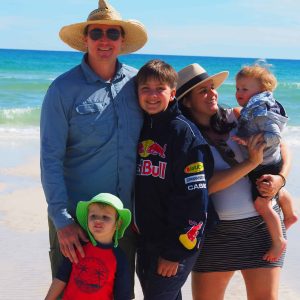
Your Hosts: Karly, James & Family
With nearly 40 years of unforgettable Fraser Island (K’gari) holidays under their belt, James and Karly fell in love with Orchid Blue and became its proud owners in 2019. Since then, they’ve been lovingly restoring the home to its former glory—infusing every corner with care, comfort, and coastal charm to create the perfect island getaway for your family too!